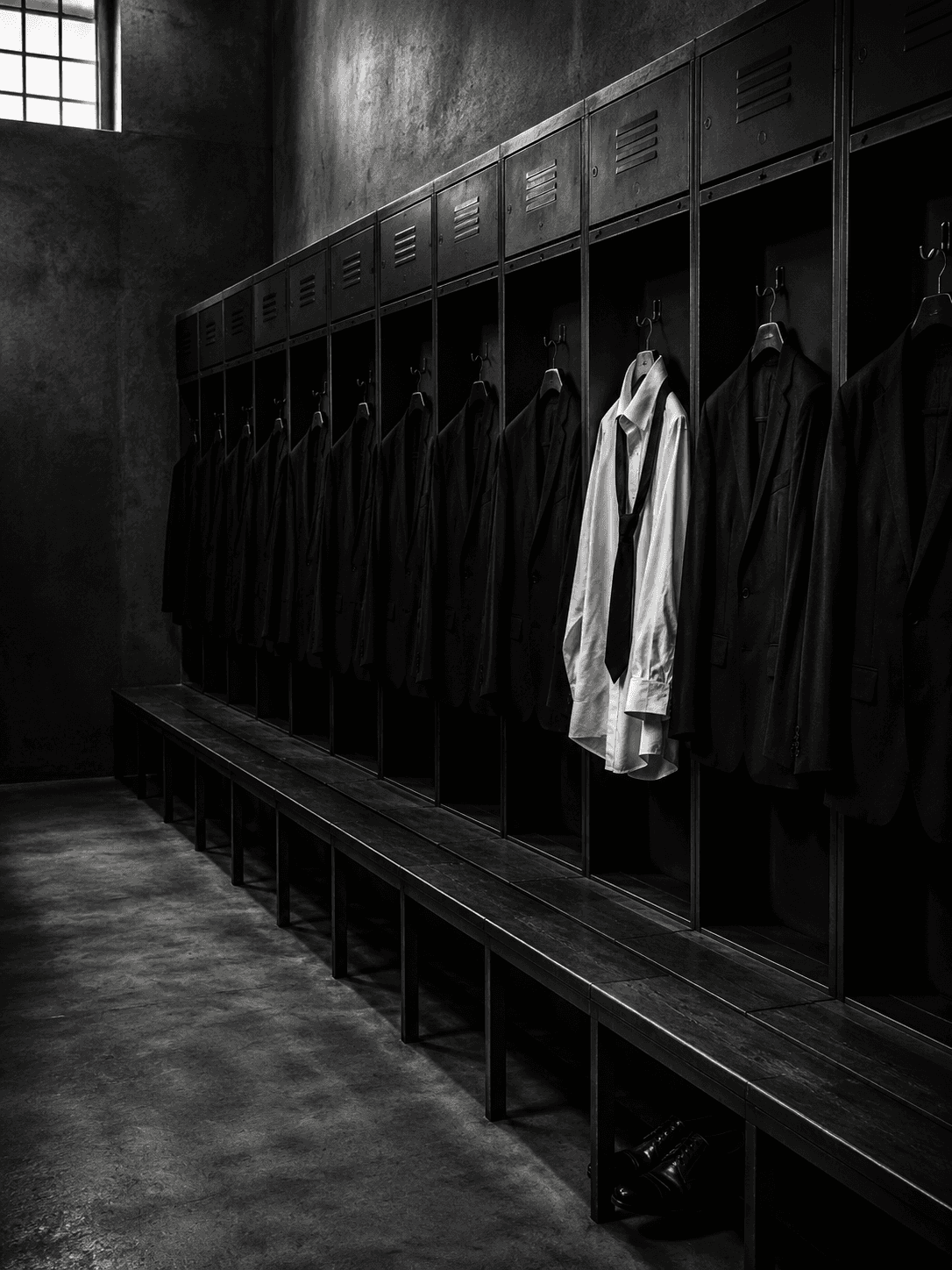
Somewhere in the unrecorded dawn of our species a knife was raised over a child, words of beauty recited, and the first horror of our new world. We spoke of growing up. We told the child that some portion of the soul it had brought with it was a temporary thing, a milk tooth of the spirit, something that would fall away on its own in a healthy child and would have to be pulled out of a stubborn one. And the child, who trusted the loving hands that held it, agreed. We are all the accomplices of our own mutilation.
The first and most cunning work of civilization. It persuades the human animal that becoming an adult requires becoming less. We treat the years as though they should add to us, then build every passage into adulthood around lessening ourselves. The boy is congratulated on the day he stops weeping. The girl is praised on the day she stops striking the world with her small furious fists. Each is handed an award in the speech of loss but reads it as honor. We treat the scar as character. The absence as maturity.
We have built our ideal of the adult around a grievous disfiguration we agree never to mention. To be an adult is to have successfully replaced one's own soul with a set of habits.
What if adulthood, as we have practiced it, has more often meant becoming less human than becoming more complete? We assume the path of life bends toward completion, that the old are wiser because they have gathered, that experience adds up like coins in a jar. We do not grow, we simply form a scab over the debris of our renunciations. Then look at what we demand of the ripening person. We demand less. We demand that the field of emotion wither until it fits whatever form the culture deems appropriate.
And we, the children of children, forget and never mourn the severed limb. A man who has not wept since boyhood does not mourn his tears. He believes he was built without them, and he will fight you to the death in that belief. We heal so completely that the scar vanishes, taking with it every memory that there was ever anything there to lose. The knife keeps carving through generations. It no longer needs to cut. It need only persuade each new child that the missing thing was never part of the body to begin with.
Take any virtue you believe belongs to one sex, strip it of its supposed opposite, and watch what it becomes. Courage is the favorite of men, the thing we have guarded most jealously as masculine. Yet courage with no tenderness in it is no longer courage. It is appetite for danger, a hunger to test the body against the world for the pleasure of it, willing to waste other lives as readily as its own. The soldier who can charge a hill and cannot grieve the men who fall beside him is not courageous. He is numbed with momentum. True courage knows precisely what it risks and risks it anyway, weeping inwardly the whole while. It is the weeping that makes the courage mean something.
So with all of them. Justice, set apart from mercy, sours into vengeance. The judge who has purged compassion from his heart does not grow more just. He becomes a distributor of pain, mistaking coldness for fairness right up to the day he sentences the innocent without a thought. Discipline severed from love becomes cruelty toward the self, then cruelty toward everyone the disciplined person can reach. Every virtue we have tried to make the property of one sex collapses the moment we truly purify it of its so-called opposite.
Purity is the poison.
This tells us something the whole apparatus of gender was built to bury. The virtues do not come apart. They are not separable qualities to be parceled out across two kinds of people, the hard ones to the men and the soft ones to the women, each sex specializing in half the human excellence. A virtue is a marriage. Two energies gripped in a single fist. Holding them is difficult. That is the point. Tenderness with no strength behind it is mere sentimentality. It helps no one. It dies upon the first demand. Strength with no tenderness is brutality. It helps no one. It kills. The excellence lives only in the union, and the union has no sex.
What we have praised as masculine virtues and feminine virtues, then, were never virtues. They were the broken halves of virtues, and we gave one set of halves to one person and the other set to the other person, praising this as complementary, as though two cripples propped against each other made a single walking person.
Wholeness is difficult. To hold strength and tenderness in one fist. To feel grief without drowning and act without becoming cold. To be soft enough to be cut and hard enough to survive being cut. This is the finest labor of mankind. Most lives are not long enough. It asks everything. It never finishes.
Human beings found a way to be excused from it.
Gender became the excuse. The great pardon, signed by nature herself, or so we claimed, releasing each of us from this assignment of becoming human. The man who cannot endure his own sorrow need not wrestle it into some livable form. He says only, that is not for me, I am a man, and the culture nods, granting him his exemption. The woman who would rather not summon her own ferocity, who finds it easier to be acted upon than to act, need not forge that ferocity in the hard fire. She says only, that is not for me, I am a woman, and again the culture nods.
Two human beings have just been excused from becoming whole.
This is moral laziness. Most of our cowardice we are at least ashamed of. We hide it. We lie about it. We know we failed. The cowardice of refusing to become whole, however, has been turned into virtue. Virtue, however, is just fear that no longer has a place to hide. The man who has never once let himself be moved is not thought frightened of his own depths. He is thought solid. The woman who has never claimed her own force is not thought afraid of her own size. She is thought gracious. We have taken the two largest failures available to the species and pinned medals on both.
And so gender, which might have been a small consideration, a description of certain differences in bodies and certain tendencies and no more, became the great foundation of our evasion. We needed it to explain everything, assign everything, settle in advance what each of us would and would not be required to become.
Men and women do not enter the world incomplete. The infant is not a half. We are not born incomplete. We are cut into pieces by the expectations of others. Before this cultural surgery, every small child exhibits the whole human range of emotion without leave or apology: rage and tenderness, the will to comfort beside the will to conquer, every bit of it present, every bit native, none of it yet assigned.
The child is whole.
What comes next is not nature completing itself. It is culture reaching in and tearing things away.
Each sex is robbed, robbed in the opposite direction, which is what makes the theft so hard to see. We compare the two halves, find that they fit, and pretend that is the design. The man is most often relieved of his emotional fluency. The emotions themselves stay behind, trapped. What is taken is the fluency, the ease of motion through his own thoughts, the power to know what he feels while he feels it and say it. He keeps the feelings but loses the language for them, a cruelty of its own kind, like being given a kingdom and forbidden its roads.
The woman is relieved of something else. She remains completely fluent, the fullness of the inner life, and loses instead the ability to wield force, to be the one who acts rather than the one acted upon, to make her own space and consequence in the world without an apology trailing every step.
These are not matched losses, and we should resist the urge to make them rhyme too neatly. Still, they are paired in their cunning. The man without emotional fluency and the woman without leave to use force are perfectly suited to prop against one another, each supplying what the other was forbidden. The secret of the strong is that they have forgotten how to cry. The secret of the weak is that they have forgotten how to act. It feels so much like harmony that almost no one questions it. He brings her into the world of action through his agency. She brings him into the world of feeling through hers.
Two amputees, and between them one full set of human powers. We have praised this as the natural order, even the biblical order, of things.
The tragedy is not that men and women differ. Differences are the fabric of the living world, and no one with sense would wish them gone. The tragedy is that we took the common variations of bodies and built upon them a system of mutual robbery, then taught each aggrieved party that the theft was their essence. The man does not know he is missing the paths of his emotional life. He thinks he was always without. The woman does not know she was forbidden her own force. She thinks she was simply born gentle. Each has been persuaded that an absence is an identity, and a person who believes that will defend the absence to the death because losing it now would feel like losing the self.
No civilization manufactures adults. We speak of nations and armies and institutions as though they were assembled from adults who showed up fully formed and ready to be deployed. They were not. Every soldier was first a small child being taught, by a thousand small corrections, which feelings would meet warmth and which would meet ridicule. Every cruelty a nation later proves capable of was rehearsed first in a nursery or playground, in the moment a child reached up with some native part of itself and met a voice saying, not that, never that, that is not what you are.
The boy learns through the smirk, the frown, the withdrawal of warmth at the moment he shows the forbidden thing. He learns before he has words for it. He learns that fear is funny, tenderness is dangerous, and he learns it from no single cruel teacher but from the world around him, correcting him gently, almost lovingly, each time he strays.
The girl learns a different lesson by the same wordless means. She learns which of her feelings demand an apology before they may be spoken, learns to soften the point of every desire, and that her anger above all must come wrapped in regret. She learns she may feel anything so long as she feels it quietly.
By the time these children are grown, the lessons are automatic. The man cannot recall the day he decided his grief was unmanly. There was no day. There were only a thousand corrections until the grief fell silent. The woman cannot recall learning to apologize for her own power. She knows only that the apology is there now, waiting ahead of every assertion.
Nations inherit these grown children and find them well suited to the work nations need done. The man who cannot feel his grief makes a fine instrument of war. The woman who cannot claim her force makes a fine keeper of the home and children as the bloodshed requires.
Every war begins in childhood. Not because children are warlike. They are the least warlike creatures we produce. The emotional groundwork that makes adult atrocity possible is laid quietly in the formative years by people who love the child and believe they are helping.
The mother who teaches her son not to weep is not plotting a massacre. She is shielding him in the only way her own deprivation taught her from a world she knows will punish his tears. Yet the line from that shielding to the cold and unforgiving man, and from that man to whatever he later proves capable of, runs unbroken.
We are all of us downstream of a nursery.
Emotion cannot be destroyed. Every emotion forbidden by the world is simply biding its time in the cellar, waiting to become a monster. You may forbid a feeling. You may shame it, ridicule it, drive it so far underground that the one who bears it no longer knows it is there. You cannot make it cease to exist. The energy that was grief does not evaporate when grief is forbidden. It is conserved, like every other force in the universe. It goes looking for an exit and takes whatever exit is left unguarded. What we have built, in our effort to make people manageable, is not a world with less feeling. It is a vast underground trade where forbidden emotions change hands under the guise of something else.
Grief a man may not feel does not remain grief. It ferments. It returns as rage, which is allowed, even admired. The man who was never permitted to mourn becomes the man who is always, unaccountably, furious, and neither he nor anyone near him connects the fury to the unwept loss beneath it. Tenderness that has been forbidden does not vanish. It sours into the will to control, because a man who cannot give care openly will find some crooked way to bind the people he loves to him. Domination is what tenderness becomes when denied. Fear that may not be confessed hardens into cruelty, because the frightened creature who cannot say, I am afraid, will instead make others afraid.
Nothing the culture forbids is ever subtracted from the world. It is relabeled, repriced, and sold back to us in a form we have agreed to tolerate. The tears we would not let a man weep we later pay for in his rage, his addiction, the harm he does the world. The force we would not let a woman wield openly we later pay for in the thousand bent channels that force must cut when the straight road is closed. We imagine we have a choice between a world of expressed feeling and a world of governed feeling. We never had that choice. We have only ever had a choice between feeling that moves in daylight under its own truth and feeling that moves in darkness under a forged one.
The forged ones do more damage than the originals ever could. A man weeping threatens no one. The same grief, denied and turned to rage, can change the world. A woman using her force in the open is simply a person. The same force, forbidden and driven into indirection, becomes manipulation, the bent version of a thing that was once honest. We did not make the world safer by gendering emotion and forbidding each sex its outlawed half. We made it more dangerous, because we took honest feelings and drove them into the dark, and a disguised feeling does harm an honest one never could.
Try to picture friendship before affection became a thing one sex was allowed and the other was not. It is harder than it should be because we live so far downstream that we can barely see the world before the flood. Yet it was there. There were ages and places where men touched one another without moral panic, wept in one another’s company without shame, wrote to one another in a tenderness we would now find unbearable, and none of it was thought strange. The love between friends had not yet been quarantined. A man could tell another man he loved him and lose nothing.
What was taken from men when affection between them became suspect? Friendship did not merely lose its warmth. It lost its depth, because depth requires the freedom to speak what is found in the heart. Once speaking became dangerous, men stopped reaching into that place. They learned to keep their friendships in the safer waters of competition and complaint, of toughness performed for one another, while the deeper waters fell silent. Friendship is nothing more now than the mutual agreement to overlook the fact that we are all starving in different ways. A man may spend decades beside another man, trust him with his life, and never once tell him what that trust means, because saying it has been made to bear a shame it never once bore before.
This is emotional poverty.
They mistake the loneliness for what it is to be a man.
Something else was taken from women by the same dividing knife. The emotional registers were handed to them as a duty, which is a subtler theft but theft all the same. The care that should have been a gift, freely given and freely withheld, became an expectation, demanded by virtue of being female. The moment a gift becomes an obligation it stops being a gift. The woman who comforts because she chooses wields one of the great human powers. The woman who comforts because comforting is demanded of her performs unpaid labor of the heart, and this hollows out the very thing it pretends to honor.
Men lost the leave to care.
Women lost the freedom to refuse care.
Both losses fall upon the same human power from opposite directions.
What died in this division was the possibility of friendship as the meeting of two whole people. When one party is forbidden tenderness and the other is conscripted into it, honesty cannot survive. There is only the man performing masculinity and the woman performing femininity, each playing the assigned part, each lonely inside it. Real friendship requires two people who are free. Free to give and free to refuse. Free to be hard when hardness is true and soft when softness is true. We traded that for a theater of matched deficiencies, and we have starved in the theater ever since.
Why would a civilization pour such enormous energy into dividing its people in half? Cultures do not keep up costly systems for nothing. The gendering of the soul is costly. It demands constant enforcement, constant correction, the labor of a thousand small shames to keep each person inside the assigned half. Something had to be gained, or the system would have collapsed under its own cost.
When I ask what was gained, the answer is unsettling.
The divided person is more useful than the whole one.
A whole human being is hard to steer. He feels his grief, so he cannot be sent lightly to do grief’s work upon strangers. He knows his fear, so he cannot be shamed into pretending it gone and marching where fear says, do not march. She knows her force, so she cannot be assigned, without her consent, to the endless upkeep of other people’s comfort.
Being whole yields a person who is harder to use.
The power to feel the cost of a thing and decline it on the strength of that feeling.
The whole person has a brake. The divided person has had the brake taken out in precisely the direction the system needs to send them.
Industrial life sharpened this because it ran on specialization, and specialization of the soul proved as profitable as specialization on the factory floor. The man emptied of emotional fluency makes a better laborer and, when required, a better instrument of bloodshed. He can be placed in conditions that would break a feeling man because the part of him that would register he was breaking was removed in advance. The woman, overcome with the duties of care and forbidden the force that might let her bargain over the terms of that care, sustains the workers, the soldiers, and the next generation of both, at no cost to the system that consumes her.
Two specialized half-souls, each cut to a pattern, each unable to do the other’s work and therefore locked into its own.
It is efficient.
It is efficient because it is incomplete.
You may argue that none of this was planned. It emerged the way a river emerges, because water keeps taking the easiest path until the current deepens. Civilizations that divided their people simply outlasted, for a time, those that did not, because divided people could be marshaled while whole people had to be persuaded, and marshaling is faster than persuasion. So the pattern spread. No one loved it. It worked. The things that work are the things that survive long enough to form us.
We are the heirs of efficiency.
We bear within us the mold we were poured into before we could speak.
As much enforcement as society used, it was never the smirk or the shaming that worked best.
It was the dictionary.
Long before any child is corrected by a person, the child is handed language. We imagine words are descriptions, neutral tools for pointing at the world. A great many are sentences passed in advance, moral instructions disguised as labels, and we hand them to one another all day long without noticing we are saying anything at all. We speak these softened words keep ourselves from hearing our own screams.
Strong. A simple word. Notice that it has already decided which human powers count. A man who does not weep is praised as strong, and the praise instructs. It tells him that not crying is strength, that detachment is power.
Now take its shadow.
Weak.
Notice it has been assigned with equal cunning to the very powers required to become whole. To feel deeply is weak. To need is weak. To show a wound is weak. The word does not describe a lack. It manufactures one by attaching shame to a set of human powers and daring anyone to claim them.
Watch the pairs and the whole device reveals itself.
Hard and soft.
Sensitive.
Stoic.
Tough.
Nurturing.
Emotional.
Rational.
Turn over any one of them and you find the same thing stamped underneath: an order about what a man may be and what a woman must be, buried so deeply in the language that it now feels like part of the word itself.
This is the genius of the system.
It needs no enforcer.
The smirk needs a person.
Language needs no one.
Once the meanings are learned, the words discipline us every time they are spoken. A father who would never dream of shaming his son still praises him as strong the day he stops weeping, and the shame arrives smuggled inside the compliment. We cannot praise without instructing because the tools of our praise were forged as tools of instruction.
The propaganda does not interrupt our speech.
It is our speech.
And so the gendering of the soul reaches a permanence no law could grant. Laws can be repealed. Customs abandoned. A meaning hidden inside an ordinary word keeps passing sentence long after the lawmakers are gone. We could end every formal teaching of these divisions tomorrow and they would survive, waiting inside the language for the next child to learn to speak.
To free ourselves we would have to do something stranger than changing our minds.
We would have to hear what we have been saying all along.
So let me try to picture the person on the far side of all this. Not a man who has perfected manhood. Not a woman who has perfected womanhood. Those are not the goal. They are the sickness in its most accomplished form, the half-soul polished to a shine.
I mean someone who has gone back to where they were forbidden and taken back what was stolen.
I mean a person who is whole.
I find I can barely imagine such a person.
Picture the powers together again in one body the way they existed in the child before the lessons were thrust upon them. Force and tenderness in one fist, so gentleness is never weak and strength is never cruel. Grief felt all the way down because grief allowed to move need not be survived. Ferocity that begs no pardon. Care that is a gift and not a sentence. The full breadth of the inner life and the full freedom to act in the outer one, both at once, in one person.
We have no word for this.
We have praised it as masculine when it acts and feminine when it feels, never noticing we were describing one creature while dividing it in two.
The thing itself has almost disappeared from language.
We have a word for the half-souls.
We have no word for the whole one.
The whole human being is almost always taken for a rebel. The man who reclaims his tears is not received as someone who has completed himself. He is received as someone who has broken a rule. The woman who reclaims her force is not received as someone come into her full life. She is received as someone who has overstepped.
Wholeness becomes transgression.
The complete person looks, to eyes trained by society, like someone who has stolen what they had no right to, when in truth they have only refused to be robbed.
We disassembled the human being so long ago that the pieces now look like nature and being fully human looks like revolt. The easiest thing a person could do, to become fully what they already were before we reached them, now requires something of an outlaw. We are still trying to perfect the divided human being. We mistake our amputations for our identities and defend them as though they were ourselves. Perhaps that has always been civilization’s greatest triumph. Not that it taught us how to become adults, but that it persuaded us becoming less was becoming more.
The child was never the unfinished one.
We are.
To be a man is a profession. To be a woman is a sentence.
To be human, though, has become a crime.