Such Pleasant Smells: The Bastard Saint Edition

Such Pleasant Smells

The Bastard Saint Edition

Such Pleasant
Smells

Joe Nichols

A Note on This Edition

The words in this edition remain unchanged.

The book has been rebuilt around them through new botanical artwork, typography, pacing, and design.

This is Such Pleasant Smells as it belongs inside The Bastard Saint.

Before the Garden

Foreword

W. G. Kirst
Veteran & Poet

Foreword

Monday, September 1, 2025, Hyatt Regency Sacramento, CA. Hotel lobby restaurant meal, certain to give more heartburn than flavor. Perhaps that's what the up charge was for. I poured myself into a bed I knew I'd never actually achieve deep sleep in, while wrestling with exfoliating cotton and feathers and fear. It was a walled garden for two nights, encasing a body daring not to go quiet enough to listen to the undertow.

I resisted, and failed, and reached for my phone. Flipped open Substack, the app, the place I'd sneak off to secretly, as if through a bishop's gate veiled by the shadow cast once a day by two spires built on expectation and obligation. And there it was. Title: “Unknown Number.” Subtitle: “I want to come home.”

The essay began, “The phone buzzed at 11:47 PM.” I looked at my phone, now illuminating the words I was about to read. It was 11:45 PM. I shuddered, held my breath, and pulled the sheet up. I began to read what a man I didn't know had written just two days before the universe dropped it into my awareness. I don't know how long I held my breath that night. I gripped the phone as if it contained the last molecules of oxygen on this planet. I read these words and let out a wail that could have easily earned a call from the front desk.

“Because somewhere out there, someone is drowning. Someone is reaching across the darkness, hoping against hope that somebody, anybody, will reach back. And sometimes the wrong number is exactly the right call. Sometimes a stranger's love is the bridge between wanting to die and choosing to live.”

The author went on: “Your story isn't finished. Someone, somewhere, is waiting for you to come home, even if you can't see them right now.” I couldn't see the author of this book that night. He could not see me. We knew nothing of one another's walk, existence, or anguish.

And months later I would find myself on the phone, echoing a once-in-a-generation writer's words back to him, to remind him his story wasn't over.

My reminder: “You're not alone. You're talking to me.” His retort: “You're a stranger.” My echo: “Sometimes strangers are safer.” His resistance: “Why do you care?” My resonance: “Because you reached out. That took courage. And I was taught to show up.” I'm glad I did.

Now I sit writing this foreword, and it is nearly impossible to remember a time when I didn't know this fellow Veteran, this fellow poet, this fellow writer, this fellow man.

His published works have been a pivotal part of my growth and healing this past year. His books lay strewn about my home, from coffee tables to bedside tables. The weight of the words, and the wounds, matter. Each carefully sculpted and stitched. And Such Pleasant Smells illuminates where light is never permitted by man, and where shame holds its most inescapable gravity.

In the Spring of 2020, I was scheduled to lead a workshop titled “Meeting Shame's Gaze.” It was built on a single belief: when we tend to our shame, we illuminate the places that have not known worthiness or love. Made visible, shame lessens its power over us, allowing us to grieve, and to become current with our life's joys and sorrows. The workshop was designed as a day-long space to cultivate a compassionate, honest, and holy relationship with the thing most of us spend our lives running from.

The workshop never happened. Because the world stopped a month before it was to be held, as we held our breath in fear and in death. And alongside it, buried with the same practiced efficiency I'd used my whole life, went eight months of research that had shown me, beyond any reasonable doubt, that shame is the slow killer of men.

That is, until an opening arrived in the form of the very book you hold now.

In deep conversations with Joe Nichols, I was reminded that what I had learned and what I had written was better shared than shamed or shuttered. So I shared. And learned I was not alone in the suffering.

This is the thing this book understands more clearly than almost anything I have read: shame does not grow nor travel by being spoken. It strengthens and scales by being hidden. It is passed down in our silences, not our confessions. In the half-second turning away, in the way a man holds his shoulders when someone asks how he is, in the garden tended to before the sun rises so that nothing in the soil beneath is ever seen. Joe Nichols has been in that soil. And he has stayed long enough to tell us what it looks like from below it.

This book will be his masterpiece. And it will be a peace offering to yourself, as you read and resist and hold the tension while tending to the most important garden, where your words have bloomed unseen. Until now.

You have been ashamed of your own thoughts for longer than you have understood what was yours and what was inherited.

I thought I had worked a lifetime to unseat shame and take my life back. What I was actually doing was tending my walled garden, all the while making the walls higher and higher. Until someone brave enough to speak first asked if I'd like help cutting back the ivy that had long since concealed the bishop's gate which locked me in.

It was an invitation to step beyond the craftsman's columns, out to the fields of barley, where I could bend with the wind and dance under a boundless blue sky. That invitation, I never knew I needed it. Until I did.

Thank you, Joe. For staying in the soil long enough to write this. For giving men who have been holding their breath for decades permission to finally exhale. For what your words will do in the gardens of our children, who were never meant to inherit what we buried there, and our elders buried before us.

Not for weakness do we shrink into shadow, but because the act of retreat is our sharpest skill, honed through years of living between eyes that do not see.

© Joe Nichols

The First Garden

Tomato seeds will not germinate in the soil where the parent plant grew. The parent releases chemicals that suppress its own offspring. The children must grow elsewhere or not at all.

You resent your parents for things they did not know they were doing, and you love them for things they did not know they were giving.

The Letter Beneath the Garden

Prologue

There is a letter I have been writing since I was a young man.

Prologue

There is a letter I have been writing since I was a young man. In the soil, with my hands, in the years before the house stirred. I am writing it now in the hour before the walk, in the quiet before anything in the house has moved, on my knees in the place I have knelt for fifty years. I am writing it to the people I love most, which means I am writing it to the people I have most failed to reach, and the failing and the loving have always been done by the same hands.

My father is dead. He taught me how to walk out by doing it in front of me, one sentence at a time, in the last years of his life. I did not understand what I was seeing. I only understood that the closer he got to his own shame, the closer he got to me. I mistook the closeness for reconciliation. It was not reconciliation. It was demonstration. He was showing me the path. He did not live long enough to see me find it. I am finding it now, too late for him to see, and I am putting that into the dirt because there is nowhere else to put it.

There was a woman before this one. I will not pretend she does not belong in this letter. I married her young, before I had any of the words I have now, before I understood that what I brought to our bed was already a garden, already locked, already being tended in the dark by someone she would never meet. I told myself we were corrupting each other. That was convenient. She had her rows and I had mine and we each watered what was growing in the other. It is true as far as it goes. It does not go far.

Her rows do not defend mine. Her failures do not subtract from what I did to her, which was this: I married her as a man who had already decided she would never be permitted to see me. I did not know I had decided it. I had decided it anyway. For the years we were together I handed her the vision of a man polished to not disturb the version she had fallen in love with, and I let her build her life around that, and when she began to sense the hiding I pretended it her problem and stood by that until she believed it. She may still believe it. I cannot go back and tell her. Telling her now would be another kind of tending, another kind of management, a thing I did for my own absolution and pretended was an apology. She does not owe me that. What I can do is write it here, where no one is owed anything, and say it: she never met me. Not once. Not on our wedding day, not on the day our life together ended, not in any of the rooms between. I gave her a husband. I did not give her myself. The failure of our marriage was not mutual. Some of it was. Not the foundational part. The foundational part was mine, and it was laid before she ever walked into my life.

And the one who is sleeping now, in the room behind me, the woman I have loved harder than I have loved any living person, she built her days around a man who was not entirely the man she believed herself to be loving. The man she loved was real. What she did not know about him was also real. They lived in the same body, tended by the same hands, and I could not separate them then and I cannot separate them now. What I can give her, what I am writing into this soil because I could not say it standing close enough for her to see me, is this. Every moment she felt something was wrong and could not find it, she was right. She was feeling this. She was feeling the distance between the man I showed her and the garden I kept from her, and that distance was mine to create and mine to maintain and I maintained it for the entire span of our life together, because showing her the truth felt, from inside the fear, like handing her a reason to leave. The truth is that the hiding was the reason. I handed it to her slowly, over years, in ways neither of us could see clearly, and I am sorry for that, and the sorry is not asking for anything, it is only the truest thing I have left to put in the ground.

The love was real. It came from the same soil as everything else. The soil was dark and the love grew in it anyway.

My mother. I do not know how to write to her because I am not going to write to her. She will die inside her garden. She is eighty. She has knelt every morning of her life and the kneeling is the only shape her love has ever taken, and to walk up her path and tell her that what she called love was the transmission of a wound older than her mother and older than her mother's mother would be to take from her the one thing she has. I will not take it. I have decided. The decision is its own kind of dishonesty and I am making it anyway because she has earned the right to die inside what she believes. My father got there. He walked himself most of the way out and he took me with him as far as he could. My mother did not get the same years. She got the kneeling. She will finish there. I will sit in her kitchen next month and we will talk about the weather and I will hold the secret of this walking in my mouth and not set it down in front of her, and the holding will be a betrayal, and I will bear it, because the alternative betrayal is larger and I am the one who has to decide which to commit.

I grieve her while she is still alive. I grieve the mother I would have had if her mother had not handed her the shears. I grieve her mother. I grieve the women behind her mother, whose names I do not know, who knelt in soil that is in me now whether I have admitted it or not.

And then there are my daughters, my oldest, the women now. This is where the letter gets quiet in me, because this is where I have the least right to write and the most need to. They have been women for years, living lives I have watched from the careful distance I told myself was respect. That it was trust, was the graceful release a father offers when his children become themselves. It was not those things. It was the old hiding. The maintenance of a surface so complete that no one, including me, would have to look beneath it.

I thought I was protecting them. I rose before they woke and smoothed what was difficult before it could reach them. I stood in doorways and watched them sleep and felt a love so large it had no outlet, and so it went back into the ground like everything else I felt, and I turned away from the doorway and went back to my rows, and I believed that was love. That the tending was love. That covering what I could not face was the same as keeping them safe from it.

It was not keeping them safe. It was giving it to them. I poisoned their soil.

This thing the book has been circling from the first page. Shame does not travel by being spoken. Shame travels by being hidden in the presence of a child. A father does not sit his daughter down and teach her to be ashamed. He only lives near her, and she watches him, and she learns, in the years before words, that there is a way of being that involves withholding some part of it from the world, and she does not know she is learning it, and he does not know he is teaching it, and by the time either of them has words for what has passed between them, it has already passed. The body learns first. The words come later to explain what the body already knows.

And then, when the words do come, we have built a whole world of them. Vulnerability. Presence. Holding space. Showing up. Doing the work. The language is pretty. The language is expensive. The language is lipstick on a pig and the pig is still the pig. I have said those words. I have read the books. I have paid the people who use them for a living. None of it reached the thing. The thing is not lexical. The thing is in me, in the breath going shallow when someone gets too close, in the retreat that happens a full second before the mind knows a retreat is being made. You cannot talk your way out of yourself. You can only stand in the it until the body believes it is allowed to. The standing is what nobody teaches.

The standing is what I have not done.

My daughters did not need me to explain myself. They only needed to be near me. And they were always near me. And what they received from that nearness was not only the love, though the love was in every one of its hours. What they received was also the withdrawal. The half-second turning away at the instant of exposure. The deep instinct of a man who could be in the same house as the people he loved most and still be fundamentally alone, hidden even in the hours of closeness, absent even in the embrace.

I watched it take root in them. I saw the instant it happened in each of them, separately, in their own ways, and I recognized it the way a man recognizes his own expressions in that same child, with a grief that had no direction, a grief that required him to admit what he was watching, which required him to admit what he was, and I was not ready. I was never ready. And by the time I was ready the roots were deep and the garden I had given them was already growing.

They are out in the world now, loving people, being loved, and somewhere in the loving there is a gesture that is mine. A stepping back at the moment it gets too real. A way of being present and still somehow behind glass. A way of giving love from behind the garden rather than from inside it, which is the only way I ever knew to give it, and I gave it to them, and they learned it from me before they knew they were learning anything, and they are living with what I gave them in ways I will never fully see.

I cannot take it back. I would not know how to take it back even if I could, because it has grown through everything else in them, through the strength and clarity they have built around it and sometimes out of it, and those things are theirs. What I want them to know, what I am pressing into this soil before I go, is where it came from. Not mine alone. Down through the blood. Through a long line of men and women who knelt before the dawn and believed the kneeling was love, who covered what they felt and wrapped the covering in an honorable word and passed it down as inheritance without understanding what they were passing.

It did not begin with me. I could not end it. I can only see it, and say that I see it, and trust that the saying matters even here, even in the dirt, even in a letter no one will read.

The love and the hiding were the same hands.

And then the small ones. The two who are still asleep.

My little girl. She is three. She came into my room last week and stood beside the chair and did not speak. Just stood there, breathing the way small children breathe when they are certain of their welcome, and looked at me, and I looked back, and I felt the old thing begin in me, the smoothing, the presentation, the rising-up of the version of me that the moment seemed to call for. And for the first time in my life I watched myself do it. I watched my own hand reach for the cloth and lay it across what was in me, in front of a three-year-old who had come to my side because some part of her already knew which man of me was the one she wanted and which man was the one she was going to get. She is three. She already comes looking for me through the cloth. She has already begun to learn that the father who is here is not quite the father who is answering. I taught her that. I taught her that in a handful of mornings, in the small ways I did not know were being recorded until I saw her give one of them back to me, the stepping-away disguised as patience, the turning disguised as calm, and I knew. And I knew I was still doing it. And I knew the soil around her small feet was already receiving the first of the seeds I swore I would never plant again.

My boy. The newborn. He does not yet know my face. He knows my smell. He knows the feel of my arms. He knows the sound of my voice before the words have meaning. He knows the rhythm of my breathing when I hold him against me in the first hour of the morning, before the house is up, and what he is learning right now, in the only way a thing that small can learn, is whether the body he is lying on is here or somewhere else. He cannot parse the garden. He cannot see the rows. He is only taking in, through his own small body, the question of whether the man holding him is actually where his body is, or somewhere behind it, somewhere tending. And I have been tending. I have been holding him and tending at the same time. My arms were here and my hands were here and some part of me was already down on its knees in the soil, pulling a weed, smoothing a row, and he was feeling it the way infants feel the weather, without language, without defense, with the whole of himself.

This is the part I cannot bear. The older ones, my daughters, they have already received what I had to give them, and that grief is finished, it has already happened, I am only saying it here because saying is the last thing left. But the small ones. The soil around them is still soft. The roots have not set. Whatever I do in the next hour, whatever I become on the other side of this gate, or whatever I fail to become, is going into them right now, this morning, in the silence of a house that has not yet woken.

I am terrified. I have spent my life finding more dignified ways to say it and every one of them was another row in the garden. I am terrified I will stand up from this soil and still be the same man. I am terrified I will not stand up at all, that I will find another honorable word for staying, and that my little girl will come to the bedside next week and I will hand her the cloth again without seeing my hand move. I am terrified my boy will learn the rhythm of a closed heart before he has words of his own, and that by the time he has the words, he will not have these ones, because this will simply be what a father is, the way it was simply what a father was to me, the way it was simply what a father was to mine.

I am writing to them now. I am writing to the one who can almost understand me and the one who cannot understand anything yet, and I am writing the same sentence to both of them, and the sentence is this. I saw it in time. Not early. Not early enough to spare the older ones. But in time for you. In time, maybe. If I can do this one thing. If I can stand up from this dirt and not kneel back down. I do not know if I can. I have never done it. The men I come from did not do it. But I am trying it now, this morning, before you wake, because you are the reason the trying has finally cost less than the not-trying. The older ones showed me the inheritance. You are why I am refusing to finish handing it over.

I am sorry for what is already in you. Some of it is already in you. I held you with the door closed more times than I will ever be able to count, and whatever that taught you, has already learned. I cannot unteach it from this side. But I can stop teaching it. I can stand up. I can come back to you as someone else. I can sit beside your bed with nothing over what is in me, and I can let you look, and I can trust that what you see is enough, because you have not yet been taught that it is not, and if I move fast enough, if I rise now, you may never have to learn it from me.

That is what I am trying. I do not know if I can do it. I might not. That hurts. I might not.

Here is the only thing I have left to give any of you. Not the husband. Not the father as I performed him. Not the son my mother thinks she raised. Not the man the first one married and the man the second one is still married to. Those were all of them the garden. Those were all the tending. They were the most beautiful thing I could grow because they were all I could bear to be seen growing.

The only thing I have left is the one who was here before the garden. The one who has been sitting underneath it for fifty years. The one I hid so well I forgot him, and then remembered him, and then hid him again, and then could not hide him anymore. Him. That is what I am giving you. That is all I have.

If you can love him, I am free.

If you cannot, I am free, and I have lost the people I love most, and I do not know how I will bear that, and I am not going to pretend I know, and I am not going to dress it up in something that makes the losing sound like growth.

But I have to be free.

I cannot give you anything else. I have nothing else. The garden is all I ever grew and the garden is what I am walking out of and if what is left of me is not enough for the people who have loved the garden, I understand. I understand and I am going anyway. Not because I love you less. Because staying had become the deepest lie I was telling and you deserve better than a lie, even one I had convinced myself was love, even one I had convinced myself was protection, even one I had worn for so long I could no longer feel it against my skin.

I loved you from inside the garden. The first one. The second one. The older ones. The small ones still asleep.

The small ones will wake soon.

I am going to be standing when they do.

I am going now to learn what loving looks like from outside it.

He withdraws.
Not all at once.
A little less each time.

A single thread of saffron comes from the stigma of one crocus flower. The plant does not know it is valuable. The value is a story we told about it.

The Daily Weed

Passion flowers grow false egg-like structures on their leaves to discourage butterflies from laying real eggs there. The butterfly sees competition and leaves. The deception is visible only to the butterfly.

You are ashamed of the small lies more than the big ones, because the small lies are what you are made of.

The Garden

I tell you this man's garden was a kingdom. Not a kingdom of conquest but a kingdom of hours. Every bloom in it was a promise he had kept. Every row was a sentence he had spoken to the ground and the ground had answered. You do not pass a garden like this without knowing that a man has given himself to it completely. That he has withheld nothing from the soil that the soil required. That he rose before the world rose and knelt before the world knelt and put his hands into the dark earth the way a surgeon puts his hands into the open body. With that much purpose. With that much belief that what he touches he can save.

I tell you about the jasmine. It climbed the eastern wall the way a rumor climbs through a family. Slowly at first and then everywhere at once. He had planted it seven years ago and it had not betrayed him. Not once. Seven seasons it had bloomed when the season demanded and he could not say this about any person he had ever trusted but he could say it about the jasmine. Its scent reached the road before its color did. A sweetness so thick you could almost lean against it. Women passing would close their eyes and breathe and for a moment they were not on the road anymore. They were inside something. Something that had been built for them without their knowing.

I tell you about his hands. They were not gentle hands. They were hands that had learned gentleness the way a violent man learns prayer. Slowly. Over years. Through repetition so constant it became a kind of faith. He could feel the difference between soil that was ready and soil that was grieving. He could hold a seedling at its base and know whether it would survive transplant. These were skills. These were conversations. His hands spoke a language the earth understood and the earth answered in color.

I tell you about the roses along the gate. They were red in a way that made other reds seem like apologies. Deep. Unembarrassed. They bloomed unabashed and open and they did not close at night the way lesser flowers do. They stayed open in the dark as if to say we are not afraid of what comes when the light leaves. He had spent three seasons training them to the gate and during those three seasons he had spoken to them the way you speak to a child who is testing you. With patience not natural but chosen. With a voice that does not rise even when directions are refused.

I tell you about mornings in this garden. The dew sat on the leaves like a congregation waiting to be addressed. Mottled light flickering through the branches, landing on the soil in patterns so deliberate they seemed rehearsed. And the birds. The finches came first. Then the wrens who were cautious and needed convincing. Then the cardinal who sat on the same fencepost each morning and opened his mouth as though the entire garden existed so he could sing above it. And perhaps it did. The keeper did not look up when the cardinal sang but his hands would slow for a moment. Just a moment. As if even his hands needed to listen.

I tell you about the herbs along the southern wall. The rosemary stood upright like little soldiers. Rigid. Fragrant. Certain. The basil spread with an eagerness that bordered on reckless and he loved it for that because nothing else in his life was reckless anymore. He could brush it with his forearm and that scent would linger for hours and the scent was a companion he did not have to explain himself to. The thyme crept along the stone path and got into the cracks and spread where it was not invited and he let it. He let the thyme go where it wanted. This was the single liberty in a garden that otherwise obeyed him completely.

I tell you about the tomatoes. He grew them from seed. His hands were the first and only hands they had known. From the dark of the starting tray to the vine to the fruit heavy enough to bend the stake, he had attended every stage. He would lift one in his palm and feel the warmth of it and the weight of it and there was a completeness in that he could locate nowhere else. A thing begun and finished and held. The skins were tight with color. Red so deep it crossed into purple. Yellow so honest it seemed to be confessing something. He placed them in the basket with a care that in any other context you would call love.

I tell you about the afternoon light in this garden. How it moved through the rows like a hand across a sleeping body. How it found the zinnias and made them almost impossible to look at, so bright they seemed to be burning from inside. How it turned the soil from brown to gold for one hour and during that hour the garden was more than he could bear. A place where precious things are kept. And the keeper would stand at the far end and look back at what he had made and his face in that light was the face of a man who has found the one thing he can control and has controlled it beautifully. It made him ache.

I tell you about the fence. He built it himself. Cedar. Sanded until the grain rose and you could run your finger along it and feel the life the tree had lived before it became a border. People rested their arms on this fence. Neighbors. Strangers. People who were not even going anywhere near his house but who changed their path to walk past because the garden pulled them. And they would lean on his fence and look at what he had built and something in them would go quiet. Something they had been carrying would set itself down for a moment. And they would say how do you do this. And he would say I just tend it. And they would nod as if he had given them a philosophy when he had given them nothing but the most practiced sentence he owned.

I tell you about the evening. When the light withdrew and the colors settled into themselves and the garden went from performance to patience. He would walk the rows one final time. Checking. Not for disease or damage but the way a man checks the locks on his house before sleep. Making sure everything is where he put it. Making sure nothing has shifted. Nothing has crept out of its designated place. And when he was satisfied he would go inside and wash his hands and the water would run dark with the soil he had been holding all day and he would watch it spiral down the drain and he would feel something leave him. Not the dirt. Something else. Something he would have to go out and retrieve in the morning. Something he always retrieved.

I tell you this man's garden was a masterpiece. I tell you people drove from other towns to see it. I tell you his children grew up in the shadow of it and knew its seasons the way other children know their father's moods. I tell you his wife could see it from the kitchen window and she looked at it every day the way you look at a thing you have lost an argument with.

I tell you the garden was everything he said it was. Every blossom. Every scent. Every perfect row.

I tell you he was in it every morning.

I tell you he was in it every morning.

I thought something and kept it.

It wasn’t anything.

I thought it anyway.

I looked.

But not long.

Long enough.

I finished.

I could have stopped.

I didn’t.

It didn’t happen.

I didn’t do anything.

There’s nothing to say.

I knew what it was.

I knew. And still...

Not in spite of it.

Because of it.

I didn’t take anything.

I didn’t touch anything.

I didn’t say anything.

It was mine anyway.

Do you love me?
Yes.

Silence
Silence
Silence

All right.

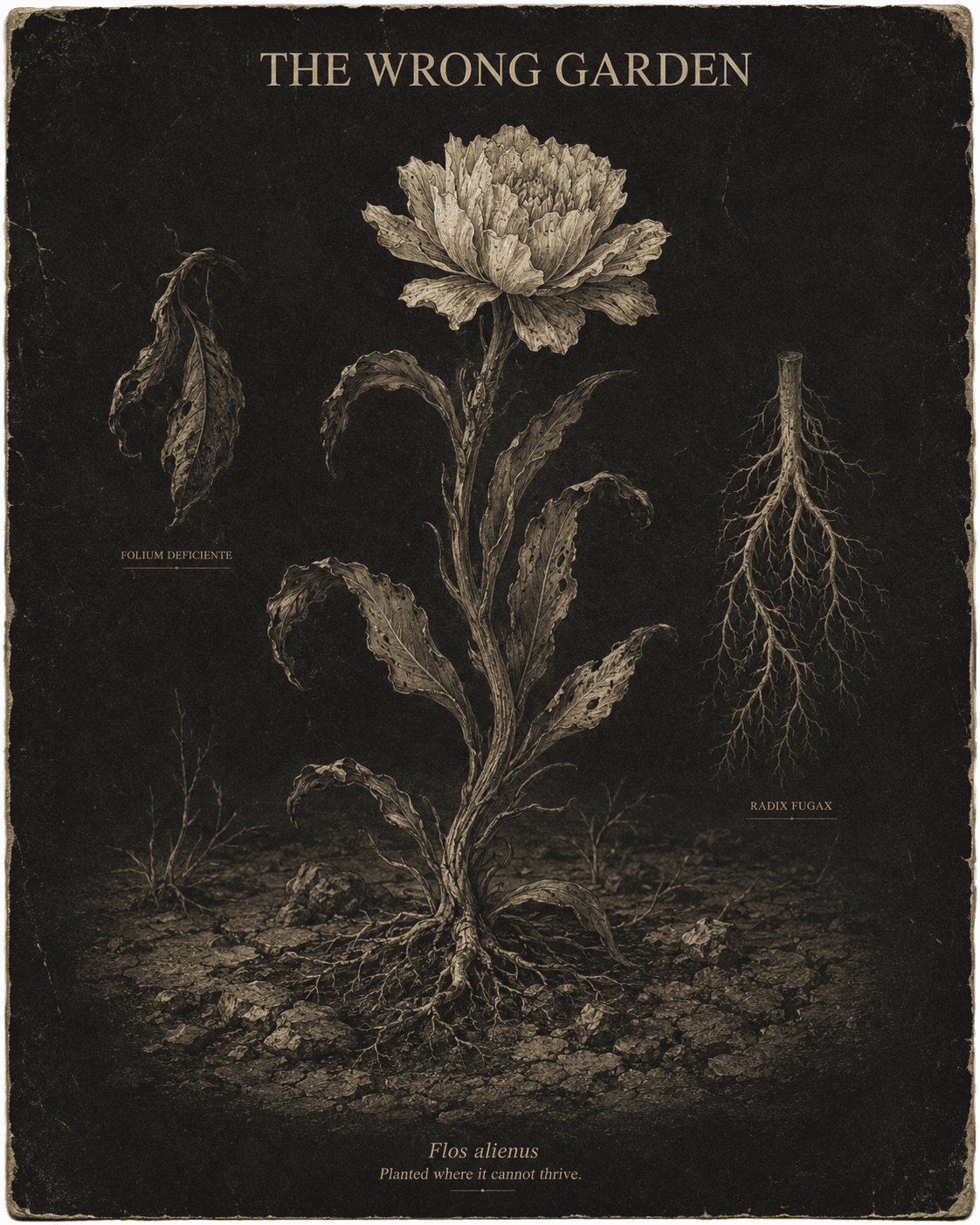
The Wrong Garden

A plant grown from the seed of a native species but cultivated in a greenhouse will grow into a plant that cannot survive outside the greenhouse. The conditions of its growing determine the plant it becomes. It is not the plant it would have been.

You are going through the motions of a life that was assigned to you by people who did not ask whether you wanted it. You are ashamed that the life everyone envies is a life you do not want.

Beneath the Smell

But some mornings the keeper stood among his rows and the beauty was not what reached him first. Some mornings it was the smell beneath the smell. The sweetness had a floor and the floor was something dying. It was always something dying. That is what a garden is. A negotiation between what is growing and what is decomposing and the decomposing never stops. It only gets covered. Bloom after bloom after bloom laid over the decay like perfume on a body that has not been washed.

And some mornings he could not smell the jasmine at all. He could only smell what the jasmine was planted above. And what was planted beneath the jasmine was his and he had put it there and the jasmine was the most beautiful thing in the garden and it was also the thing with the deepest roots sunk into the foulest soil.

Some mornings he envied the neighbors. They leaned on his fence and breathed in and the breathing was simple and the pleasure was simple and they walked away carrying the scent of his garden the way you carry a song you heard from a passing car. Lightly. Without cost. They did not know what the jasmine was planted above. They did not know that the roses along the gate were trained over ground that would make them cover their mouths if the roses were pulled. They saw a garden and the garden was all there was to see and he envied them for that the way a man who has built a cathedral envies the pilgrim who kneels in it. The pilgrim sees God. The builder sees the creation.

And perhaps some of it was true. Perhaps some of the beauty was truly beautiful. Perhaps the roses were simply roses and the tomatoes were simply tomatoes and not everything in the garden was a lie dressed in color. But he had lost the ability to tell. Somewhere years ago the truths and the lies had grown into each other the way vines grow into a fence until you cannot remove one without destroying the other. He could not pull the lies without killing the truths and he could not tend the truths without feeding the lies and so he tended all of it. Every morning. Without distinction. Because distinction was a luxury he had surrendered so long ago he could not remember what it felt like to know which was which.

The neighbors said the garden was a miracle. He did not argue. He had learned that a man who argues with a compliment draws more attention than a man who accepts it. So he accepted. And the accepting was its own kind of tending. A small maintenance. A tiny lie so ordinary it did not even register as dishonesty anymore. Thank you, he would say. And they would walk away satisfied and he would go back to his rows and kneel in the stench they could not smell and tend what they could not see.

For what is truth but the lie that survives the longest.

There is no sin except stupidity.

Oscar Wilde

I have not been happy.

I have been convincing.

The Shared Bed

Companion planting works because certain plants trade nutrients and repel each other’s pests. They do not know they are helping each other. They are only each other’s conditions.

You married the person you could survive. You did not marry the person you would have chosen if survival had not been the question.

One breath
and everything hidden
learns how to travel.

The Garden of Happiness

I tell you about the garden of happiness. It is the garden that has no season. It does not sleep in winter. It does not rest. It does not fade back into the root and wait the way the other gardens wait. It blooms in snow. It blooms in drought. It blooms in soil so exhausted that nothing else will grow and still the happiness garden will flower on time and the flowers are bright and the flowers are fragrant and the flowers have never once failed a season.

I tell you about the soil in this garden. It is bitter. It is acid and grief and the sediment of every thing unspoken. Every silence chosen. Every scream twisted into a smile and offered back into the earth. The soil contains everything he will never say. It is rich with the unspoken the way a forest floor is rich with what has fallen and been consumed. The bitterness nourishes the bloom. The sadness sustains the bloom. The hate he feels feeds the most beautiful flowers in the garden and they drink from it and they rise tall from it and they turn their faces to the sun and they are gorgeous because what they are feeding on is inexhaustible.

The soil in the happiness garden is not mere soil. It too is in bloom. It is blooming all the way down. Push your hands in and you find petals. Push deeper and you find stems. Push deeper and you find more petals and more stems and more color and the color never ends and the fragrance does not end and there is no rock beneath it and there is no clay beneath it and there is no bottom. He has dug. She has dug. They have both knelt in this garden scraped the dirt, reaching their hands down through the flowers looking for the ground that was there before the planting began. The garden gives them nothing but more garden. More flowers. More beauty rising to meet them as if the garden itself is afraid of what they might find if the flowers ever stopped coming.

I tell you about the roses in this garden. They are not like the roses elsewhere. Those roses are red and unembarrassed and they will bloom even in the dark. The roses in the happiness garden change. They are one color for his wife. Another for the neighbors. Another for his mother when she calls. She is one color for her husband. Another for her sister. Another for the woman she sees at school pickup who always asks how she is doing and the roses open so fast and so practiced that no one sees nothing but garden. Sometimes the roses change for the same person. The same neighbor standing on the same fence will see a different bloom depending on whether he is admiring or studying. The garden knows the difference. The garden will always witness the difference. It has done this longer than the keeper has been tending and it adjusts its display with a precision that would terrify the keeper if he stopped long enough to watch it. But he does not stop. And neither does she.

I tell you what it sounds like in this garden. It is not quiet. There are birds. So many birds. More than in any other garden. Cardinals and finches and wrens and mockingbirds that sing other birds' songs so convincingly the other birds answer them. And beneath the birds there are creatures moving through the undergrowth. Rustling. Chattering. Filling every silence with motion. The happiness garden is loud with distraction. It is dense with things that move and call and flutter at the periphery so that the keeper's eye is always being pulled away from the ground. Always being drawn upward. Toward the canopy. Toward the song. Toward the color. A man kneels and begins to dig and a cardinal lands on a branch and sings so purely that the man looks up and when he looks back down the hole he was digging has already filled with bloom. A woman sits in the quiet and it lasts seconds before a wren darts across her line of sight and she follows it without choosing to follow it and the moment she was sitting in is gone. The garden is full of these mercies. These small interruptions that come exactly when the keeper gets too close to the soil. He has never noticed the timing. She has never noticed the timing. The birds always seem to come of their own accord.

The garden would never tell them otherwise.

I tell you about the fragrance in this garden. It is the strongest fragrance of any garden the keeper tends. It reaches the world before the color does. It reaches the house before the keeper has finished tending. It follows him to his car. It follows her to the mirror where she puts on her makeup and even this smells like the garden and the garden smells like the face and they are the same thing and they have been the same thing so long that removing one would remove the other. The fragrance does not wash off. It is in the skin. It is in the voice. It is in the particular way a man holds his shoulders when someone asks him how he is. It is in the particular way a woman laughs when nothing is funny but the silence needed filling. The fragrance is so deep and so constant that neither of them can smell it anymore. They can only smell its absence. And its absence lasts less than a breath.

I tell you the keeper goes to this garden first. Before any other. In the dark. Before the sun has said a word to the horizon. He is already there. She is already there. Tending. Not because it is the most beautiful garden. Because it is the garden that stands the deeper gardens of her being. If this garden fails the others are naked. And so the keeper tends it first and tends it best and the flowers know this. They open for the keeper with loyalty. With obedience. With a faithfulness that would break your heart if you knew everything it hid. But you do not and will not ever know. Because even the keeper does not know. Because there is nothing to see here but bloom. And the bloom is beautiful. And the bloom is creation. The blooms, they covered whatever came before it so completely that the keeper cannot tell you what the garden replaced. Only that something was here once. Before the flowers. Before the fragrance. Before the first seed. Something was here and the keeper has spent a life planting over it and the planting is so thick now and so deep that the thing beneath it may already be gone. It may have been digested by the roots decades ago. It may be nothing now but fertilizer. Nothing but the rich bitter soil that feeds the most beautiful garden the keeper owns. The most beautiful garden anyone has ever seen.

The most beautiful garden the keeper will ever tend and never understand and dare not stop tending and never once see the bottom of.

I keep my secrets the way a man keeps his worst thoughts, close and fed. I am ashamed not of what I hide but of how well I hide it. I confess to feel less guilty, which makes the confession itself a lie. I have learned that shame is a form of currency and I am wealthy beyond measure. I would rather be interesting than good. I tell the truth strategically, which means I do not tell the truth at all. I am ashamed that I enjoy the taste of my own dishonesty. I confess only what I can afford to lose. I hide things not to protect others but to protect the image of myself I have sold them. I am ashamed of my certainty that everyone else is doing exactly this.

I hide the parts of myself that are actually alive because the dead parts are easier to manage. I am only honest when I am sure no one will believe me.

The Sealed Plot

Certain bulbs store enough food to survive without sunlight for years. They wait beneath the surface for a season that may never come.

You have secrets that will die with you, and you have made peace with the dying.

What the Garden Stands On

The lie that has been tended so faithfully and so long that it has grown its own roots and its own blossoms and its own scent. The lie that has become indistinguishable from the soil itself.

He knew this. Not as a philosophy. As a daily experience. He lived inside a garden where the oldest lies had become structural. They were not decorations anymore. They were the ground he stood on. Pull them and there would be nothing to stand on. So he watered them too.

He watered the lies with the same hands that watered the truth and the water did not know the difference and the soil did not know the difference and most mornings neither did he.

Some days the light hit the garden and even he was fooled. Even he stood at the far end and looked at what he had made and felt something close to pride. And on those days he could almost see the neighbors believed. He stepped into their experience of his life and rested there.

But the smell would come. It always came. Not from any single plant or any single plot but from beneath. From the layer where everything he had buried was still alive and still breathing and still sending its stench up through the beauty like a confession the ground was making on his behalf.

And on those mornings he did not tend with love. He tended with an urgency that puzzled anyone watching. Tying the blooms back into place. Adding soil where the soil had sunk. Covering what had begun to surface.

And this was the tending no one saw. Not the patient morning gardener the neighbors admired. The frantic man on his knees pushing things back into the ground before anyone noticed they were rising.

An inexhaustible capacity to engage in sin is what makes human beings capable of living a virtuous life. To err is human; to seek penance is humankind’s unique act of salvation.

Kilroy J. Oldster
Dead Toad Scrolls

The Thorn Bush

Some plants do not merely warn themselves. After a single injury, chemical signals travel through the plant and alter how new leaves form. Future growth becomes defended before the threat returns.

The damage is remembered in the next body it produces. The thing you never said to the person who deserved it is the thing you say to everyone who does not.

Love, Failure, and the Body

I love her yet I immediately am hiding from her what that love requires of me. The more I felt it, the more carefully I build myself around what would not disturb her. I pretend this is for her protection. What I am protecting is my image of myself in her eyes. I know this even as I do it. That is what makes it unbearable.

One self feels, another self evaluates. They cannot occupy the same moment. Love becomes a conflict between experiencing and judging, with judgment always winning.

I have been loved. I did not believe it. This has been the main problem of my life, and I have never said so out loud.

In Dante, the second circle is for the lustful, who are blown eternally by winds they cannot resist. I have always thought the circle for those who could not receive love should be deeper. They stand alone and waiting in silence, while love knocks at the door.

Defectus. Latin. A falling short. A running out. Used in medieval theology to describe the absence of a good that should have been present. My failures have been defectus.

Not sins. Absences. What should have grown, and did not, and cannot be summoned back by wanting.

I am good at my job. This is not the saving grace it appears to be. I am good at a job I did not choose, did not want, and cannot now leave, because the competence has built a wall around a life I meant to have. I have been rewarded, for years, for not becoming what I intended to become. The reward has been the thing I cannot walk away from. My success is the exact same shape of my failure. I have spent decades believing these were two different things. They are one, described from different angles by people who want different things from me.

A dying man told me: I did not do the thing I came here to do. He did not weep. He said it the way a man describes a past trip. I did not understand him. I am older. I understand him now. Most of understanding him has been living long enough to construct the same sentence. I am not dying. I am only at the age where the sentence becomes audible. It has been in me for decades, waiting for the conditions under which I would be able to hear it. The conditions are silence, exhaustion, and retrospection that has nothing to recommend it over any other view. I hear the sentence now. I am going to hear it for the rest of my life. It is not going to quiet. It is not going to resolve. It is only going to be there, the way tinnitus is there, the way a cold draft is there, present and unfixable and eventually unremarkable.

The first time a woman undressed in front of me, I closed my eyes without meaning to. I was nineteen. I did not know I had done it until she asked me why. I did not have an answer then. I have the answer now. I had never seen my own body without looking away from it, and I had not yet learned how to look at a body that was not mine.

The body wants things. It wants food. It wants rest. It wants to be touched. It wants to move. It wants to lie still. The wanting is constant and unapologetic and it has nothing to do with the mind's opinion of what the body should want. I have been at war with my body's wanting since I was small. I have called the wanting gluttony, sloth, lust, weakness. The wanting does not care. It continues. It is happening right now, as I write this. It will continue until I die. It is the most reliable voice in me, and I have been refusing to listen to it for fifty years.

Frisson. French. The sudden shiver of pleasure or excitement. I felt it sometimes as a child. I do not feel it now. I did not feel it leave. I only noticed, at some point in my forties, that it had been gone a long time. I cannot summon it back. The body, having learned not to startle, does not relearn easily.

The body will kill me. This is the only certainty I have. It will kill me through one of the thousand small failures that come with the design. A vessel. A cell. A bone that breaks and does not heal in time. The body is the instrument of its own ending. I have known this intellectually since I was ten. I have begun to know it the other way, the way a man knows a fact in his own hands, only recently. This knowledge has changed how I walk up stairs. It has not changed much else. It will. I am waiting to see what.

Tolstoy wrote that happy families are all alike, and that each unhappy family is unhappy in its own way. I read the line at nineteen and agreed with it. I read it again at fifty and disagreed. Unhappy families are all alike. They share much the same, the same silences, the same scripts passed down for generations. What is unique is only the decor. What is unique is the wallpaper against which the same injuries play themselves out. Tolstoy had it backward, I think. Or I have lived long enough to see a different truth than he saw. I am not sure which.

I have been a son for fifty-seven years. I will continue to be a son until my mother dies, at which point I will become what Kafka called ein Kind ohne Kindheit — a child without a childhood. The phrase is from his letter to his father, which I read every five years or so, when I need to be reminded that my relationship with my own father was not unique. Kafka's father was harder than mine. Kafka's response was sharper. The shape is the same. A son writing a long letter to a father who will not read it, or who will read it and misunderstand it, or who will read it and die before answering. Most letters to fathers are this letter, in some form. Most of them never reach the recipient. Most of them are written so the son can read them himself.

Wilde said that to resist temptation one must yield to it. I have yielded many times in my imagination and resisted most times in the flesh. The bookkeeping would confuse a saint and amuse a demon, and I suspect it would reveal me, to anyone paying attention, as the kind of coward that society rewards most handsomely.

My browsing history is the most honest document about my inner life that exists anywhere. If I am ever canonized as a saint, they will have to destroy it first. If I am ever remembered as a monster, it will be the evidence.

Proust wrote that we are attracted by a small detail and that once attraction takes hold, we invent the rest of the person to justify the detail. I have done this at least a thousand times. The women I imagined were more various than the women I met. The imagined ones never disappointed me. The real ones were always themselves, which was the problem, because I had not been ready to want a real person, only my invention of one, and my inventions do not exist to be lived with.

The Grafted Vine

Companion planting works because certain plants trade nutrients and repel each other’s pests. They do not know they are helping each other. They are only each other’s conditions.

You married the person you could survive. You did not marry the person you would have chosen if survival had not been the question.

There is in a man’s breath
a confession and a lie.

He sits, wanting what he cannot say,
and trembles with the effort of restraint.

where longing grows wild and untended

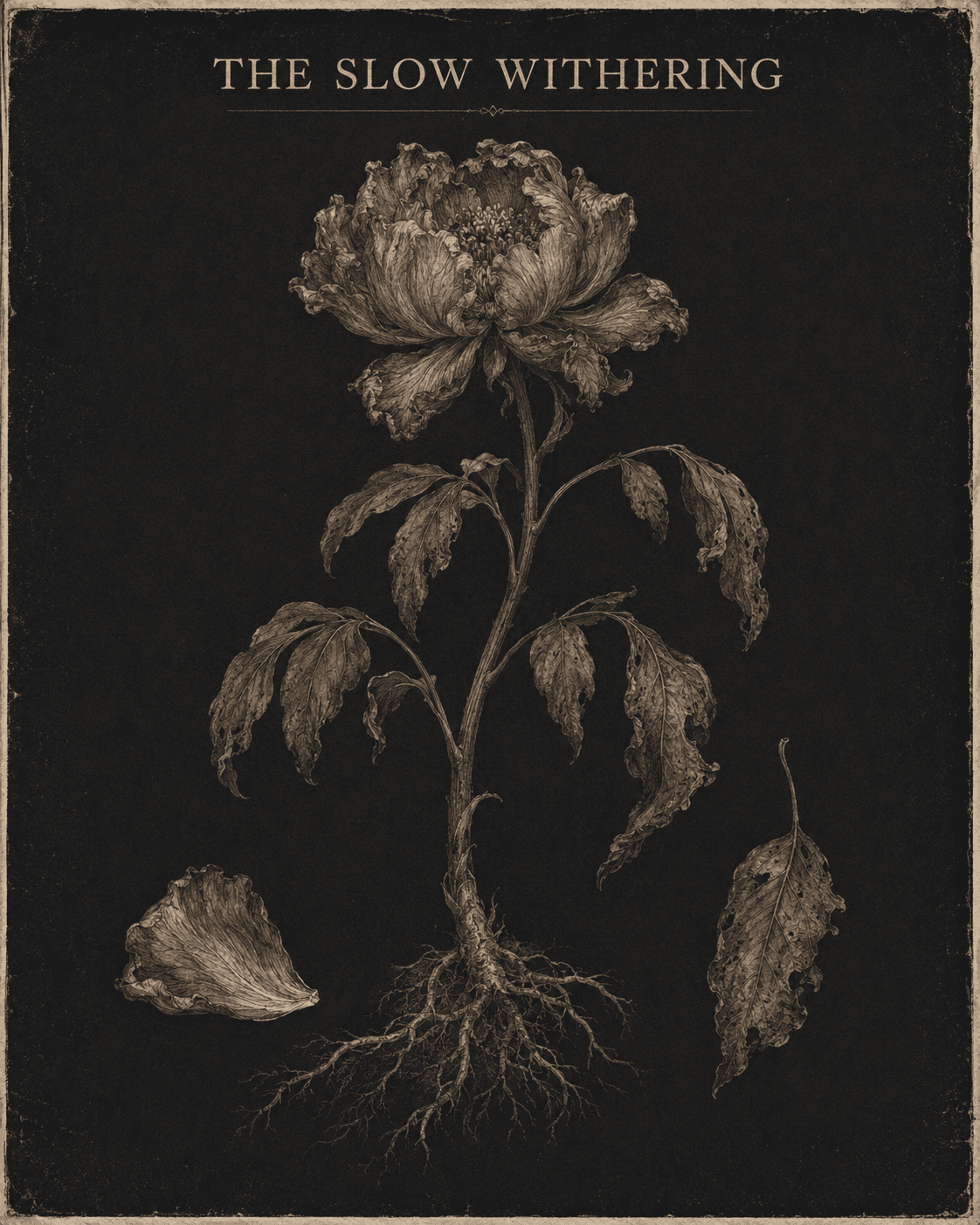
The Slow Withering

A bristlecone pine can live for five thousand years. Most of the tree is dead wood. The living part wraps around the dead part, and together they continue.

You are ashamed of your own aging in ways you will never say to another person.

Darling remember, when you come to me, I’m the pretender.

Gillian Welch
Time (The Revelator)

The Neighbor’s Flower

Plants grown too close together stretch upward competing for light. The stretching makes them weaker. The competition deforms every one of them.

Envy is the shame you have not yet admitted is the thing driving your decisions.

The Silent Harvest

Some plants produce both nectar and poison. The same species that feeds one insect kills another.

Your morality is for an audience that includes yourself, and you are the hardest to convince.

Add Plate 01

Grafted fruit trees bear the fruit of the scion, not the rootstock. If the graft fails, the rootstock takes over and grows its own fruit. The fruit is usually inedible. It is what was there before anyone tried to make the tree into something else.

Your child is tending the garden you planted in them before they could speak.

I Was. I Was Not.

I was. I was not. I was. I was not. The sentence has two halves and I have been living in both. I was a man who loved her. I was not a man who loved her. Both are true. They are true simultaneously. They are true in different hours of the same day.

I grew up in a small town. I went to the state college. I took the first job offered. I married the woman I had been dating for four years because the timing seemed right. I had two children because that was what one did. I bought the house the year my wife said she wanted a house. I do not regret any of these decisions individually. I regret that none of them were decisions. They were assents to things already in motion. The life I am living is the default life of a man of my background, and I am the man who was built by it. There is no other me underneath. The me underneath would have made different choices. The me underneath did not exist. There was only ever this one.

It is useful to acknowledge that the stable identity is a late invention. Pre-modern people did not expect themselves to be coherent. They expected themselves to be inconsistent, composed of humors, subject to possession. The modern demand that we be one person, consistent across contexts, legible to ourselves, is historically unusual. It is also exhausting. We were not built for it. The shame of not feeling coherent is the shame of failing to meet a standard that our ancestors did not hold.

I have been trying, for years, to write a sentence that begins I am. The sentence does not finish. Whatever I put after the verb feels false within seconds. I am a writer. No. I am a man who writes sometimes. I am a father. Yes, but also not only that, and sometimes barely that. I am a husband. Increasingly provisional. I am tired. This is the most accurate so far. I am tired is the one I am sentence I can complete without immediately wanting to revise. This is a discouraging discovery. It suggests that identity, for me, is currently a matter of fatigue, which is not a self but a condition of being.

We have been failing as men for so long that we no longer remember what we were supposedly succeeding at, the mythological man, the strong father, the silent provider, the stoic soldier, the man who does not flinch, who does not weep, who does not ask for help, who carries the family on his back, who dies at sixty-four of a heart attack in his own garage and is eulogized as a good man, a solid man, a man's man, and we have inherited the instruction book for this man without inheriting the world in which he made any sense.

Virtus. Latin. Manliness, courage, excellence. From vir, man. The word for virtue itself comes from the word for maleness. Western ethics was founded on the assumption that to be good was to be manly. Two thousand years later we are still weighed down by that.

A man cries. He does not cry. He cries. He does not cry. A man cries in private. A man does not cry. A man cries when his mother dies. A man does not cry when his son dies. A man does not cry. A man cries.

In the Iliad, the strongest image of masculine grief is Priam, king of Troy, kneeling in the tent of the man who killed his son, kissing the hands that killed him, begging for the return of the body. Homer understood that the heart of manhood, at its truest, was this moment of abasement before loss. We have remembered Achilles and forgotten Priam.

I want to be held. I want to be held without explanation, without the need to justify the wanting, without having to frame it as some crisis. I just want to be held sometimes. I am a man in my late fifties and I want to be held. I do not ask for it because I do not know how to ask. The words were not given to me.

There is a man in me who is well. There is a man in me who is not. They take turns at the controls of the body. The well one writes letters to people he cares about. The not-well one cancels the engagements the well one made. I am the habitat they share. I have stopped trying to evict either of them. They are the tenants. I am only the address.

Add Plate 01

A garden left untended for one season looks neglected. A garden left untended for years is no longer the same garden. The original plants are gone. What remains is what the tending was holding back.

You have been ashamed of your own mind for longer than you have understood it was yours.

Add Plate 01

Crops bred for yield have lost the resilience of their wild ancestors. They produce more and survive less. They cannot live without the humans who made them.

The job you chose was the one that asked the least of the self you would have preferred to become.

“I want to drag knives over my skin, just to feel something other than shame, but I'm not even brave enough for that.”

Paula Hawkins
The Girl on the Train

Add Plate 01

Plants grown in low light stretch toward whatever light they can find. The stretching deforms them permanently. They are marked forever by what they were denied.

The reflection is the only witness who has seen every version of you and forgiven none of them.

Jack-in-the-pulpit changes sex from one year to the next. Male in lean years, female when it has stored enough. The same plant is not the same gender across its own life.

Add Plate 01

Add Plate 01

The man you were told to be was created by a man who never finished becoming one.

The woman you were told to be was composed by people who did not like women.

A single clonal plant can live for tens of thousands of years. No individual stem does. The identity is in the roots. The stems are expendable.

The you that exists when no one is watching is the one you are most afraid of.

The Field

I tended a garden for fifty years. The garden was not mine. I thought the tending was love. It was not love. It was the building of walls.

I did not know they were walls. I had walked past them my whole life and seen the sky. Other people had walked past them and seen the sky. It took fifty years of my life to understand that the sky was an illusion, and that the illusion was so good I had never questioned it, and that the people I loved had been living under the same painted sky. I know this because I had painted it for them.

I sat this morning and looked back at what I had made.

My wife was in the eastern row.

She was bent over flowers I had planted the year I was twenty-four. I had been too young to know what I was doing. I had planted what my mother planted in me and walked away from it and my wife had taken it up, the way a wife takes up what a husband leaves, because a row untended begins to feel like the wife's responsibility even when the husband is the one who put it in the ground. Her hands were older now. The soil on them was not hers. It had come from my mother, through me, into her, and she had been keeping it alive for thirty years while I tended other rows and believed I was the one doing the work of the marriage.

My daughter was in the far corner.

She had been kneeling there since she was small. The corner was where I had buried what I could not bear to know about myself. I had arranged the rest of the garden so I would never have to walk past it. She had found it anyway.

Children find what their parents refuse to face. It is a child’s instinct. She had been tending what I would not tend, believing the tending would earn her my attention or would heal what I could not heal or would at least keep the feelings buried while I was away. She was grown now. She was still there. Her knees bore the bruises of a shame that had never been hers and had been hers for as long as she had been a person.

My mother was in her own garden, next to mine.

I had always believed my mother loved her garden. I believed the tending was her joy. I believed the rows she kept were the expression of who she was. I saw this morning that she had been tending because her mother had taught her to tend, and her mother because of her mother, and so on back into a line of women I will never know, who learned early that kneeling was the only way to stand. My mother is alive.

She is old. She is still kneeling. She does not know that the rows are walls. I cannot go to her and tell her. She does not have years enough left to spend relearning her own life. Or she does, and I have no right to force this anyway. Or she would not believe me, and the telling would only become another row between us. I do not know which is true. I only know I cannot hand her what I have come to understand. She will die inside her garden, and her dying will be what she believed a life should be, and that is not a tragedy I am permitted to voice for her.

My father is dead.

I understood him only in the last years he was alive, and I understood him because he taught me. He did the teaching without ever sitting me down. He did it by speaking, out loud, in front of me, of the shame he carried. His failures as a husband. His failures as a father. He said them out loud, the way a man speaks when he has decided the silence was the worst of it. And as he spoke I watched his shoulders square. I watched him become stronger for having said the thing. I watched him become more himself with every admission, not less. I did not understand what I was seeing. I thought it was the kind of confession a man makes when he is approaching the end and putting his accounts in order. It was not confession. It was a man walking out of his own walls and speaking to me while he walked.

He did not make it all the way out. He did not know the walking had any destination. He only knew that the speaking of shame made him lighter, and the lightness felt like truth, and the truth was worth more to him at his age than his dignity had been worth at forty. He kept walking. He kept speaking. Every year I knew him was a year he was further out than the year before. We grew closer every year of his walking, because a man walking out of his walls becomes available in a way a walled man cannot. I did not know I was being given a lesson. I thought I was being given a father. I had been given both, and the one was the other, and I did not see it until I stood at my own gate this morning.

He had been teaching me the only thing worth teaching. Speak the shame. Say it out loud. Watch your shoulders square. Watch yourself become more of what you are. He had been giving me the beginning of the walking, and I had received it as closeness, and I had been grateful for the closeness without understanding that the closeness was the evidence of his walking, and his walking was the path he was trying to show me.

I grieved him this morning not as a son grieves a father who failed to love him, but as a son grieves a father who was showing him the way out and did not live long enough to see the son begin the walking himself. He would have wanted to see it. I would have wanted him to see it. Neither of those is available to me now. I have only the memory of his shoulders squaring every time he said another true thing, and the memory will have to do the rest of the work.

I understood, sitting in the dirt, that my tending had never been love.

My tending had been the maintenance of a small walled place I had mistaken for the world, and I had been pulling everyone I loved into it, not by force, but by my own refusal to leave. My wife had arranged her days around my tending. My daughters have built their childhood around the corners I would not enter. My mother had kept her own garden in order partly because her son kept his, and our gardens had held each other up the way two walls lean together and become, between them, a kind of shelter.

I had not been loving them. I had been keeping them.

There is no single word in our inheritance for what I had been doing. It is what love becomes when a person has never been shown another way to love. It is what my mother gave me. It is what her mother gave her. It is the only inheritance my family has ever passed down.

I sat with this for a long time. I did not weep. I had wept in this garden before and the weeping had never changed it. I only sat and understood.

The greatest act of love I had left in me was not going to look like love.

It was going to look like leaving.

I say what this cost, because anyone who reads this and thinks about doing it themselves should know what they are choosing.

I walked to the gate. The gate had always been open. I had not known this because I had never tried to push it outward. The gate moved easily. I stepped through.

Before I had taken three steps into the field, I heard my wife behind me.

She had picked up the shears.

She had seen me set them down and had come, out of love, to continue the tending. She did not know the rows were walls. She could not know. I had not been able to tell her, because telling her would have meant staying, and staying would have meant rebuilding everything I was trying to let fall. She picked up the shears and went to the eastern row and knelt where I had knelt, and her hands began the motions my hands had done for years, and I heard her doing it, and I did not turn around.

I heard my daughter run to the corner.

She had seen her father leave and her mother reach for the tools, and she had understood immediately, in the way daughters understand, that the garden needed her now more than ever. She ran to the corner and knelt in the shame I had finally walked away from and began to tend it harder than she had tended it in all the years of her childhood. She was doing it to save me. She believed that if she tended enough, the garden would survive my leaving, and I would come back, and the family would continue. She was a good daughter. She is still a good daughter. I did not turn around.

I heard my mother cross the fence into my garden.

She began to water what I had let go dry. She was old. She should not have been doing the work. She did it because her son had stopped doing it, and because a mother does not let her son's garden die while she is still breathing, and because she had been tending since she was small and did not know how to stop. She knelt in rows that were not hers. She had come to save me too.

I kept walking.

This was harder than anything I had ever done. I had spent fifty years tending so the people I loved would not suffer. Now I was walking away while they picked up my tools and tended in my place, believing my leaving was the suffering, when my staying had been the suffering all along, except they could not see it yet, and I could not make them see it, because making them see it would have been another form of tending, and I cannot do that anymore.

I walked. I did not turn around.

The shame of leaving is greater than the shame of staying.

The world that built the walls does not have words for what I am about to say. The world will tell you that a man who stops tending his garden is a man who has failed his family. The world will tell you your wife is heartbroken, your daughter is abandoned, your mother is disgraced. Your friends will come to you and say, go back. They will say it with love. They will be wrong, but they will not know they are wrong, because they are still inside their own gardens and the walls there still look like sky.

You will now bear a new shame.

The old shame was the shame of wanting, of being, of not measuring up to a standard no one had ever measured up to. The new shame is the shame of being the one who stopped. The one who let it wither. The one who watched his wife kneel in dirt she did not need to be in and did not go back to take the shears from her hand. The one who let his mother, alive and old, cross a fence to water rows that should have been allowed to die.

You will carry this new shame for the rest of your life. It will not leave. It will be the cost of the one honest act you have been able to perform. You will not be rewarded for the act. You will not be thanked. The people who love you will not understand, not yet, maybe not for years, maybe never. You will die, possibly, without any of them understanding. You will have to trust without evidence.

You will have to trust that your walking out, held long enough and without defense, will eventually exhaust the tending of the people who rushed in to save the garden. You will have to trust that their bodies cannot sustain the tending of an abandoned place forever. You will have to trust that love, unsupported by the original keeper, will eventually set down the shears and look up. And when love looks up, it will see the walls. And love will find its own gates.

But you will not be there to see it.

You will be in the field.

I am in the field now.

I cannot hear my wife anymore. I do not know if she has set down the shears. I do not know if my daughter has risen from the corner. I do not know if my mother has gone back to her own garden or if she is still kneeling in mine. I am not allowed to know. Knowing would be tending. I have stopped tending.

I will bear my new shame the way my father bore his. Out loud, when I can find the words. In silence when I cannot. But I will not hide it. Hiding was the first wall, and I am done building walls.

There is a thing my father told me, near the end, that I did not understand at the time. He said every man comes to a morning when he has to decide whether to tend his field or raze it. He said most men tend. He said the tending looks like love and is not love, and that a man who tends past the morning he should have razed becomes the warden of everyone he meant to protect. I did not know what he was telling me. I thought he was speaking of regret, the way old men speak of regret, reaching for meaning in what has already happened. He was not speaking of regret. He was telling me what he had finally understood, and he was telling me because he loved me, and he was hoping I would hear it before my own morning came.

My morning came.

I have razed.

Add Plate 01

Many ancient sacred groves still stand because no one dared cut the trees. The trees outlived the belief that saved them.

What Remains After Belief

The God you were taught to fear has been replaced by a God you cannot quite picture, and you miss the first one.

What is the I that is depressed? I am asking this seriously. If the chemistry of the I is what produces the depression, then the I is not separate from the chemistry. The I and the depression are the same thing, briefly. When the chemistry changes and the depression is gone, who has been lifted. The same I. But the I felt different during the depression, was different, and did different things, and said different things, and wanted different things. The I is not stable enough for the question to have a simple answer. I have been multiple I's, and some of them have wanted to be alive, and some of them have not, and they have all named themselves me, and I have answered to all of them, and I do not know which one was the real one, because the real one is whichever one is here now, and the one here now is the one writing this, and he is, at this moment, well enough to write.

They told us, the men of my generation, that anger was a flaw to be corrected, a disease to be treated, an embarrassment to be hidden, a thing only animals and bad husbands and broken people indulged in, and we believed them, and we swallowed our anger for years, and the anger has been compounding inside us at the interest rate of all unspent things, and we are now in our late fifties carrying around the accumulated rage of half a century, well-mannered, smiling at the dinner party, listening attentively to the wife of the colleague we cannot stand, and we are not going to die of heart attacks, we are going to die of swallowed sentences, of unspoken refusals, of the strain of having been polite for longer than any organism was ever designed to be polite.

I scared my daughter once. She was eleven. I yelled. I saw her face. For half a second I was glad she was afraid. I have not stopped thinking about that half second.

You don’t revisit certain moments because you remember exactly how you looked in them.

A secret kept long enough becomes a parasite that feeds on the host, that requires the host to maintain conditions favorable to its survival, that begins to make small adjustments to the host's behavior, the host's relationships and choices, until eventually the host is organizing his entire life around the secret without knowing he is doing so, and the secret has become the central organizing principle of a life that, viewed from outside, appears to be organized around love or work or family, but is in fact organized around the perpetual labor of keeping a thing hidden, and the labor is invisible because it has been distributed across every minute of every day for so many decades that it has become indistinguishable from the texture of being alive, and the host cannot stop without feeling that being alive itself is being threatened, which is exactly the situation the secret has been engineering since the day it was first kept.

Everyone has a secret. The interesting question is which secrets people choose to keep. Most people choose poorly. They keep the small embarrassing things and broadcast the genuinely shameful ones. I have done the opposite. The small embarrassing things I have published in my memoirs. The genuinely shameful ones I will take to the grave. This is the only useful piece of advice I can offer about secrets, and almost no one follows it.

There are people you could not stand to meet again not because of them, because of who you were in front of them.

I am a man composed mostly of what I have not said. The said part is the visible part. The not-said part is the larger part, the truer part, the part that has been doing the actual work of being alive while the said part has been doing the public relations.

Intimacy is what people demand from one another after they have run out of anything interesting to say. What I want from intimacy is to be known. What I do when offered intimacy is hide. The two are inseparable. The wanting is the knowledge of what I am hiding from. The hiding is the proof that the wanting is real. If I did not want it, I would not hide. The hiding is intimacy in negative, a relationship to the thing structured entirely by avoidance. I have had a lifetime of intimate hiding. I have had very little of the other kind.

You have made yourself easier to understand so no one has to decide if you’re worth understanding.

I have been intimate with several people. Each of them was a different version of me. None of the versions know each other. None of the people I was intimate with know each other. The intimacies are filed in separate folders. I am not the same person across the folders. The intimacies cannot be combined. It is the only way I have managed to be intimate at all.

Intimacy is the prize advertised at the entrance and never actually distributed inside the building. We line up anyway. We line up our entire lives.

A man of conviction is a man who has been lucky enough never to be tested. A coward is a man who has been tested honestly. The two are otherwise indistinguishable, and the coward, being more self-aware, is the better company.

Most of what we praise in ourselves as patience is actually cowardice. Most of what we praise as wisdom is cowardice. Most of what we praise as compromise is cowardice. The trick of our self-image is that we have a hundred flattering words for the one thing we are doing. The thing is fear. The vocabulary is camouflage. To examine one's life honestly is to perform the linguistic operation of stripping the camouflage, sentence by sentence, until what remains is the fear, naked, present, the actual content of the decisions we have given other words to.

They told us God was watching. They told us God was love. They told us God had a plan. They told us suffering had meaning. They told us death was not the end. They told us all of this on church mornings for twenty years while we were children, and we believed them, because they were the adults, and the adults were not in the habit of deceiving us, except about this, about the largest of all subjects, about which they were not honest, were not honest in unison, were not honest from the pulpit and from the table and at funerals and at weddings and at births, lied to us because they themselves had been deceived, withheld the truth because they could not bear the alternative, performed the falsehood as a kindness to themselves and a cruelty to us, the cruelty being that we now have to spend our adult lives unlearning what they so carefully installed, and the unlearning has been the whole intellectual labor of my middle age, and the unlearning is not finished, and may not finish in the years remaining to me, because the installation was so thorough, and the unlearning is so slow, and there is so much resistance in between.

They built cathedrals to a God who, if He existed, would not have wanted cathedrals.

I am fifty-seven. My father died in his eighties. I have no idea how many years to become the man I have not been. I am not going to make it. I am going to die mid-sentence, like he did, with the work of becoming still on the desk.

Are you all right? my daughter asked me on the phone last week. Yes, I said. You sound tired. I am tired. Are you sleeping? Yes. Then why are you tired? I did not know how to tell her that I am tired the way men of fifty-seven are tired, which is not the tiredness sleep addresses, which is the tiredness of having been the same person for too long. I said: I think I'm getting a cold. She said: Drink water. I said I would. We hung up. I did not drink water. I sat at my desk for an hour.

There is a young man in me. He still wants what young men want. He is appalled by the body he wakes up inside. He believed, until very recently, that there had been some mistake, that this was temporary, that he would shortly be returned to his actual body. He is beginning to suspect there has been no mistake. He has been waking up to it for several years now. He has not yet accepted it. I do not know how long the suspecting and the other can continue before the young man finally surrenders. I think the answer is: forever. I think the young man inside the old man surrenders only at the moment of death, and reluctantly, and with a final protest no one will hear.

My mother is eighty. She does not want to be a burden. She apologizes for being old. I do not know how to tell her she is not a burden. I do not know if I am telling the truth.

Dear younger self, I am writing you from the future. I will not tell you what to do differently, because you would not listen, and because most of what you are about to do, you will need to do, in order to become me, and most of what you are about to do, in retrospect, was not the wrong choice but the only choice that was available to you given who you were at the time. I will tell you only this: the body you have right now, the body you are not paying attention to, the body you criticize in the mirror, the body you push past its limits without thanks, that body will be the body you grieve at fifty-seven. Look at it. Notice it. Thank it. You will not believe me, because you do not believe in the future. I did not believe in the future either. The future is here anyway. I am sending this back to you from inside it. The body is the only body. There will be no other. I am sorry I did not write this letter sooner. I could not have. I had to become the man who would write it. I am now that man. Yours, etcetera.

I am married. I have four children. I have friends I have known for twenty years. I am lonelier than I have ever been, and I do not know how to say this to anyone, because saying it would mean admitting that none of them are reaching me, and I do not know whether the failure is mine or theirs or no one’s.

Loneliness is the great unspoken condition of modern life, the thing everyone has and nobody mentions, the thing we have all agreed not to discuss because the discussing would require an honesty that none of us have been trained for, the thing we paper over with calendars full of obligations and feeds full of acquaintances and rooms full of family, all of which produce the appearance of connection while the actual connection withers underneath, and we know it is withering, we feel it withering every evening when we close the door and the day's noise stops and the silence comes and the silence is the truest thing we have, the silence is what we have actually been living inside the whole time, and the silence has been lonely for years, for decades, for as long as we can remember, and we cannot say so, because saying so would alarm the people who believe they are connected to us, and we cannot bear to alarm them, and so we continue, alone in the silence, every night, while assuring everyone around us that we are not alone at all.

How are you? the cashier asked. Good, I said. How are you? Good, she said. We were both lying. She knew I was lying. I knew she was lying. We had performed the script we had been given. She handed me my receipt. I left the store. The performance was the closest contact I had with another person all day. I drove home thinking about it. I am still thinking about it.

Add Plate 01

A bristlecone pine can live for five thousand years. Most of the tree is dead wood. The living part wraps around the dead part, and together they continue.

You are ashamed of your own aging in ways you will never say to another person.

The most honest thing I have done today is sit alone for an hour and not pretend I was doing something else.

Are you happy? my wife asked me last week. Why are you asking? Because you don't seem happy. I'm fine. I didn't ask if you were fine. I asked if you were happy.

You can feel the exact moment someone loses interest in you.
You pretend you can’t.

The Second Draft

I think of a city in which every adult walks around carrying a small portrait of themselves at age six. The portraits are kept in their pockets. They are consulted privately, usually at moments of distress. The portraits do not age. The adults do. Now imagine that one morning every parent in the city wakes up and discovers that their child has become the portrait. The child is now the size of the portrait, the texture of the portrait, the ageless permanence of the portrait. The parents must carry their children in their pockets. The children look out at the world with their parents' six-year-old eyes. This is, of course, what is already happening. The city is not imaginary. The portraits are the children. We have always been carrying ourselves around in this form, and looking at our own youth in the small face of our offspring, and pretending the resemblance is a coincidence rather than the central fact of biological existence.

A son is the second draft of his father, written by his mother, edited by the world, published without the author's consent. The reviews come in over decades. Some are favorable. Most are mixed. The author cannot revise. The author is dead in the sense that matters most for revision: he has lost authority over the text. The son becomes whatever he becomes, and the father, watching from his diminished position, recognizes phrases of his own in the son's speech, and is unable to determine whether the recognition is gratifying or humiliating. Usually it is both. Usually the father has no one to confess this to. Usually he takes it to his grave, where the recognition continues posthumously, in the son's children, who carry his words without knowing whose they were.

You don’t avoid people. You avoid the version of yourself they remember.

I was in a small town in the south of Italy, sitting in the square in the late afternoon, and I watched a grandmother walking with her granddaughter. The granddaughter was perhaps four. The grandmother was perhaps seventy. They walked at the same pace, took the same small steps, paused in the same places. The grandmother stopped at the bakery. The granddaughter stopped at the bakery. The grandmother bought a small pastry. The granddaughter took it. They continued walking. Three blocks later they passed a man sitting on a bench. The grandmother nodded to him. The granddaughter nodded to him. The grandmother said something in Italian. The granddaughter said the same thing in dialect. I had been observing them for perhaps fifteen minutes. I understood that I was watching a transmission that had been occurring in this town, in approximately this form, for two thousand years. The granddaughter would, in fifty years, walk through the same square with her own granddaughter, and the same gestures would be performed, and the same Italian words would be spoken, and the line would not be broken, because the line is not a tradition, the line is a girl watching her grandmother and becoming her without choosing.

My daughter has my hands. She uses them to push me away.

What to do when you see yourself in your child: Do not look away. Looking away will make it worse. Do not apologize. The child does not want to be your apology. Do not explain. The child has heard your explanations. Do not promise to be different. You will not be. Sit with what you have given. Let the giving be what it was: love, contaminated, the only love you knew how to give at the time. Try, if you can, to give one thing now that you did not give then. Anything. Small. The child will notice. The child will not say so.

There exists a manuscript, attributed to a fourteenth-century Persian astronomer, describing a marriage between two people who agreed at the outset to keep one room of their house permanently locked, and to never speak of what they imagined was inside it. The manuscript reports that the marriage lasted sixty-one years, that the couple was considered the happiest in their district, and that when the husband died his widow finally opened the room and found it empty. She is said to have wept for a week from gratitude. The manuscript does not survive. I have read about it in a footnote to a book I no longer own. I cannot verify any of its claims.

Do you ever think about leaving me? she asked. No, I said. Liar, she said, and laughed. She was right. I had thought about it that morning. I had thought about it last week. I had thought about it for years, in small intervals, never seriously, never with intent. I did not know how she knew. I did not ask. The refusal to ask was a small mercy I extended. She extended a similar mercy by not pursuing the question. We have been extending these mercies to each other for years. The mercies are the marriage. The marriage is what we do not say.

There is a point in every conversation where you feel yourself become effort.

I think about marriage as the most extended performance of a self that any human being is asked to give, more sustained than the performance of one's career, more consistent than the performance of one's parenthood, the marriage being the place where one is meant to be most oneself, which means it is the place where the distance between performance and self is most painful, most visible, most available to the spouse as evidence of what is wrong, and yet the spouse, being equally engaged in their own performance, rarely gathers the evidence, and we live alongside one another in our parallel performances, occasionally suspecting the other of insincerity but never indicting them for it, because the indictment would expose our own performance, and the mutual non-indictment is the structure that allows the marriage to continue past the point at which both parties have privately recognized that the original promise of authentic shared life is not going to be kept.

A marriage is two people each writing a different book about the same events, neither showing the other the manuscript, both believing they are co-authoring a single story.

Marriage is the only conversation that lasts long enough to forget what it was originally about.

She has what I wanted. She did not work harder for it. She did not deserve it more. The world simply gave it to her and withheld it from me and there is no court to appeal to, no clerk to file the grievance with, no panel that will hear the case. The unfairness is the structure of existence. I am supposed to accept this. I have not accepted it. I am fifty-seven and I have not accepted it and I am not going to accept it and the not-accepting is its own small life I have been living adjacent to my actual life for forty years.

You have defended something you no longer believe in because you had already committed to being the person who believes it.

Imagine a society in which every person carried a small ledger, given to them at birth, recording every gift the universe had bestowed on them and every gift it had withheld. The ledgers are visible only to their owners. They are consulted privately, usually at night. Most people, on examining their ledgers, conclude that the withholdings outweigh the gifts.

The room remained locked
for sixty-one years.

When she opened it, there was nothing inside.

The mercies are the marriage.

The marriage is what we do not say.

The Ledger

This is statistically impossible. The gifts and withholdings, summed across the society, must balance. The impossibility does not affect the conclusion, because the comparison each person makes is not with the average ledger but with the ledgers of the few people whose gifts they happen to know about. The comparison is therefore always unfavorable. The unfavorable comparison is the fuel of envy, and the fire has been burning, in this society, for as long as anyone can remember. The society is not imaginary. The ledger is not imaginary. You are reading from yours right now.

I envy people who do not envy. I have been studying them for years. I have not learned how they do it. I have considered the possibility that they are lying. I have concluded that some of them are. The rest, the genuine ones, appear to have been built differently. I do not know what I would have to give up to become one of them. I have been unwilling to give it up. The envy is therefore mine to keep.

There are people who speak bluntly and are thought cruel for it. There are others who speak carefully and are believed kind. I have increasingly found myself in the second category, though I am no longer convinced this is a moral achievement rather than a technical one. It is possible, I think, to become so good at not causing disturbance that one forgets how to register whether anything real has been said at all.

I used to think eloquence was a form of truth. Now I suspect it may be the opposite. A method by which truth is made socially survivable. The more refined my speech becomes, the less it seems capable of carrying anything that might disrupt the beliefs of those listening. I notice, with some unease, that I have begun to trust this refinement as though it were integrity, when in fact it may simply be the ability to remain unchallenged.

I used to think eloquence was a form of truth.

Now I suspect it may be the opposite.

The Woman at the Bed

She is sitting on the bed. The half she pulled up is smooth. The half he slept in is open. She has not finished. Her hand stopped on the sheet some time ago and has not moved since.

She knows he is leaving. She has known it for longer than this morning. She has known it the way a person knows something they have yet to be told, by the small changes in a life that betray a fact the mouth has not yet said.

She thought, when the moment came, that it would feel like betrayal. It does not feel like betrayal. He is not betraying her. He is doing something else, something she does not yet have a word for. He is becoming a man she does not know.

She has been married to a man for a long time. She is realizing now, slowly, with a clarity that is almost worse than confusion would be, that the man she has been married to was not entirely the man who is in the garden right now. The man in the garden right now is someone else. He has been somewhere else, inside her husband, for a long time, perhaps forever. She did not know he was there. He was quiet. He let her husband do the talking.

Her husband was a good man. Her husband was easy to love. The other man, the one who is in the garden now, the one who has stopped being her husband, is not easy to love. She does not know yet whether she can love him. She is afraid that the answer is no. She is terrified.

She thinks: I married a kind man.

She thinks: the kind man was a costume.

She thinks: the kind man is also him. The kind man is not nothing. The kind man is what he was able to be. The kind man got us through.

She thinks: the kindness was always his. The kindness is going with him. What is being left at the gate is the quiet. The long quiet. The years he held himself smaller so the marriage could fit around him. The man who walks back through the gate, if any man walks back, will be the same kind man, and a stranger. The kindness will be the same. He will not be.

She does not know whether she is grieving the man or the costume. She suspects the answer is both.

She has watched the performance get harder. She has watched him grow tired in a way sleep did not address. She has watched him become a man going through the motions of a life he could not feel. She had not let herself say what she was watching. She had told herself it was age. She had told herself it was the long arc of marriage. She had told herself many things. The things she told herself were the same things he was telling himself, in the silence next to her, every night.

If she calls him back, he will come. And the coming back will kill him slowly, the way it has been, but faster now, because he has seen the gate, and once a man has seen the gate he cannot unsee it. The staying afterward is no longer ignorance. The staying afterward is a betrayal of what he knows, and that is a kind of death sharper than the dying of a man who never knew the gate was there.

She would have her husband. He would not have himself.

This is the choice. She is sitting with it. She does not have words for it. She is making it, slowly, and this life is producing an answer she does not want.

She thinks: if I call him back, I save the marriage and I lose him. If I let him walk, I lose the marriage and I do not know what I save.

She thinks: he knows this. He knows I could call him back. He knows he would come. He is walking anyway. The walking is not because he does not love me. The walking is because he loves me enough to refuse to keep being the lie. The walking is the first true thing he has done, and the first true thing is a leaving, and that is a kind of love, and I do not know what to do with a kind of love that looks like this.

She thinks: I could survive in shame. We have been surviving in shame. We are good at it. We have built the entire life on it. We could go on. We have the equipment. We have the routines. The shame is familiar. The shame is the oldest companion in this marriage. It would not be hard to invite it to stay. It is already here. It has been here the whole time.

She thinks: he is offering me something else. He is offering me the chance to find out whether there is anything underneath the shame. He is not offering it as a gift. He is offering it because he can no longer not offer it. The offering is involuntary. The offering is what is left of the man he was when he had no choice but to leave. The offering is in the form of his back, walking away from the house, through the gate that has always been open, into a place she has never seen.

She does not know if she wants to find out.

She does not know if she has it in her to find out.

She has been a wife.

If I call him back,
I save the marriage
and I lose him.

If I let him walk,
I lose the marriage
and I do not know what I save.